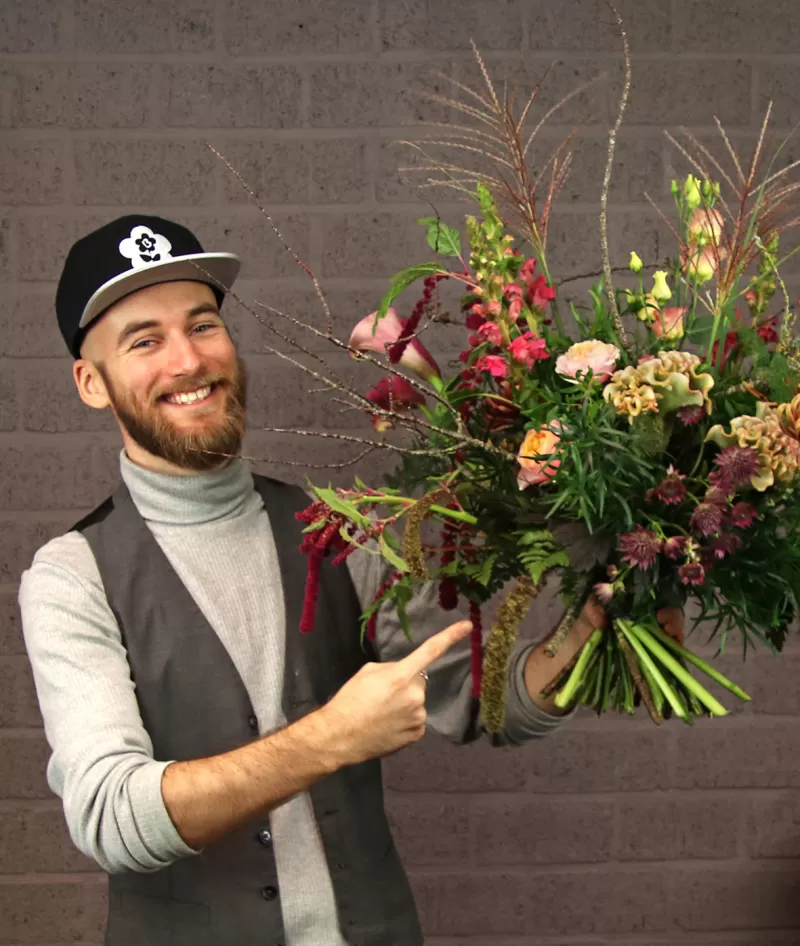
very year, we invite a renowned designer to create a Floral Trend Report to inspire fellow florists. This time, we teamed up with Mike Boerma. His floristry work takes him across the globe, and as a member of the Boerma Instituut, the world of floristry also comes to him. With so many influences, we are in for a treat.
Inspiration from all over the world
Mike Boerma: "Inspiration can be found in many places. It can come from the origin of all things, nature, by simply strolling through and observing her, but it can also come from people. During my travels, I’ve had the privilege of meeting many incredible and inspiring designers from around the world. People full of passion for our profession. People who love to explore, experiment, and innovate. People who love to educate; gathering knowledge and techniques, then sharing them with others. Their inspiration continues to fuel my own teachings at our school in Aalsmeer.
This trend report is a collection of ideas that I believe are highly relevant to today’s world. It’s also a gesture of gratitude to those who have inspired me. Through my interpretation on these pages, I hope to inspire you in turn."
Trend 1: 100% organic
Inspiration: Spain & Gregor Lersch
After completing my studies at our own school, much of my further learning has come from Gregor Lersch. His calm and effective teaching style, combined with his endless drive and passion for the craft, has always been a personal inspiration. Gregor has long championed organic materials and plant-kind floristry. From what I’ve heard, even back in the 1990s, he was a strong advocate for these ideas, though the wider industry was not quite ready for them at the time.
About five or six years ago, he and Hitomi Gilliam hosted a series of online Zoom classes on this very topic. Around that time, he was experimenting with many ways to replace traditional, non-biodegradable techniques with methods that are 100% compostable. Having followed, participated in, and assisted with many of his classes at our school, I was greatly inspired by these techniques.
By simply using bamboo instead of plastic tubes, and beeswax with food colouring instead of paraffin candles, we can create a wide variety of eco-friendly structures. Waxed hemp rope, containing no wire, also offers many possibilities. That said, the wire inside paper-covered wire is so thin it composts quickly as well.
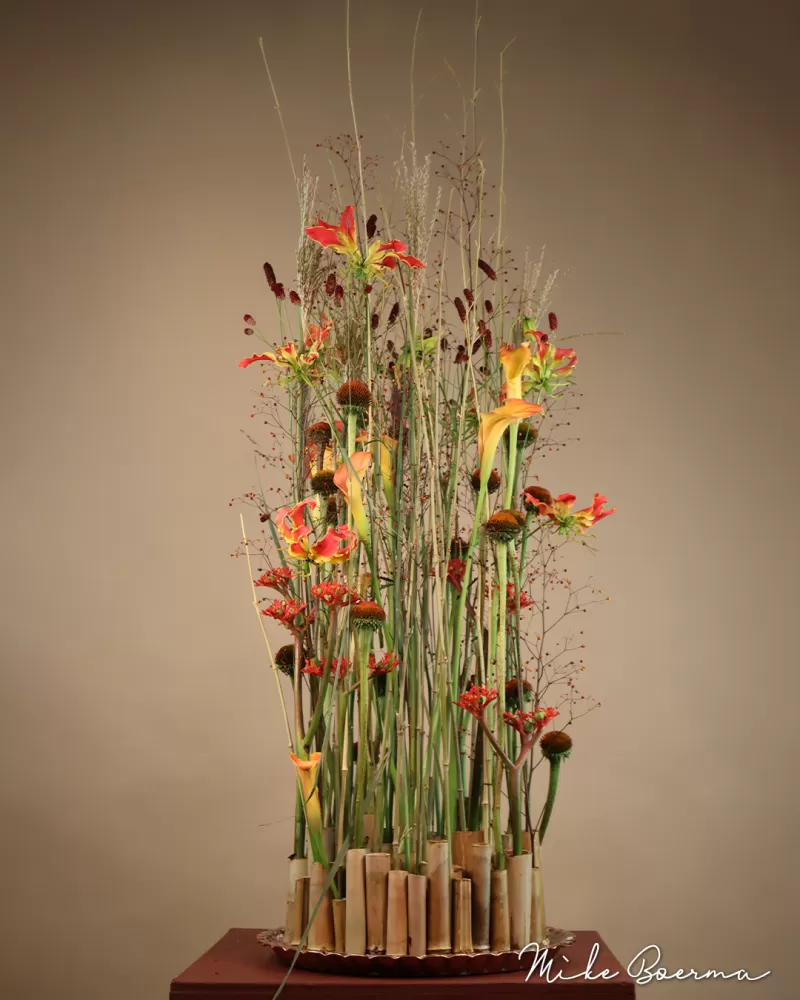
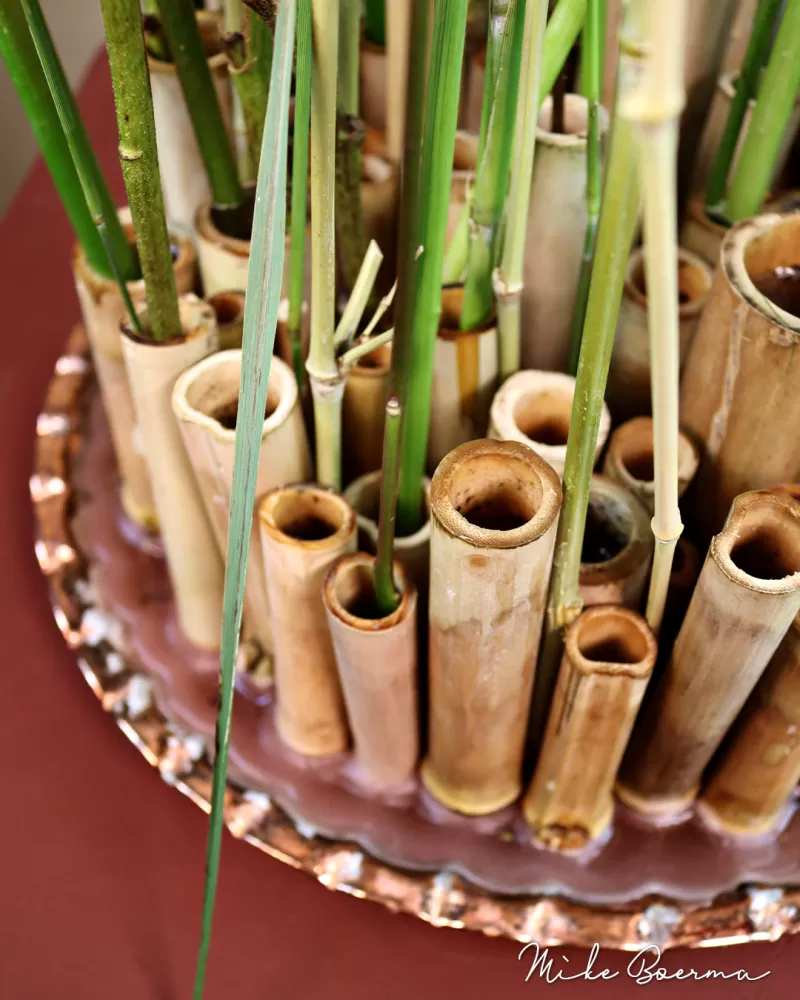
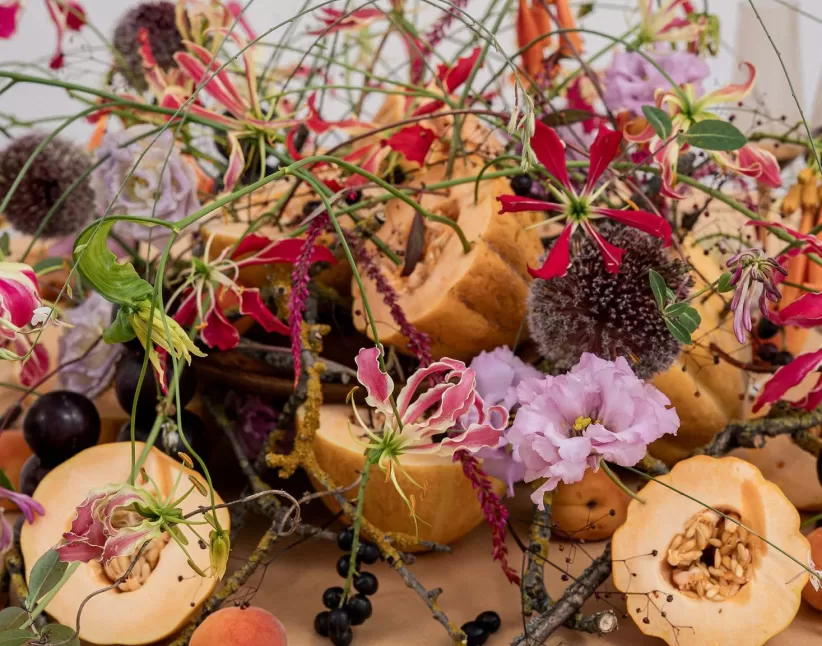
Flowers: Jatropha Firecracker, Gloriosa Superba Simba Fifty Shades, Sanguisorba Red Dream®, Talinum ‘Long John’, Miscanthus White Cloud, Echinacea Purpurea
Of course, the possibilities are endless, but I wanted to showcase a simple design that I believe is achievable with limited resources. This piece is made entirely of bamboo, originally tied together with rope. Once the beeswax with pink food colouring solidified, I removed the rope, leaving behind a stable structure. Bonus points if I had used a nice wooden or bamboo plate, but instead I reused an old copper plate that has served us well many times before. Personally, I don’t believe that biodegradable designs require a compostable container, but I always aim to avoid plastic when creating such pieces.
The colour palette of this design was definitely inspired by warmer regions - specifically, Spain. While the flowers in this arrangement don’t necessarily originate from Spain, most are native to or thrive in warmer climates. People are often surprised when they see Jatropha for the first time. It looks like an extraterrestrial form of coral, adding a uniquely striking element to any design. Texturally, this piece features predominantly organic surfaces, mixed with waxy elements such as Zantedeschia and Jatropha, both of which have a strong wax-like quality.
Trend 2: Washi paper dreams
Inspiration: Japan, Mario Hirama, Yuuji Ueno & various friends
When I was just a few years old, we lived in Japan for a while. Ever since, I’ve felt a deep connection with the country. It has had a profound influence on my artistic interests and, in many ways, on my floristry as well. Over the past ten years, I’ve been fortunate to travel there frequently; to teach and collaborate with fellow floral artists.
Ikebana has had an undeniable impact on Western floristry. I believe that in the late 1960s and early 1970s, many Dutch florists were directly or indirectly inspired by this style. Today, Ikebana feels more relevant than ever, finding its way into our lives and current trends, often through social media. It's also a form of floristry that lends itself naturally to eco-conscious practices, using techniques like clamping and balancing botanical materials without the need for floral foam or other non-sustainable supports. To me, Ikebana is as much a philosophy as it is an art form. Out of respect for the discipline, of which I am not a trained practitioner, I’ve allowed my inspiration for this design to be drawn from other aspects of Japanese culture.
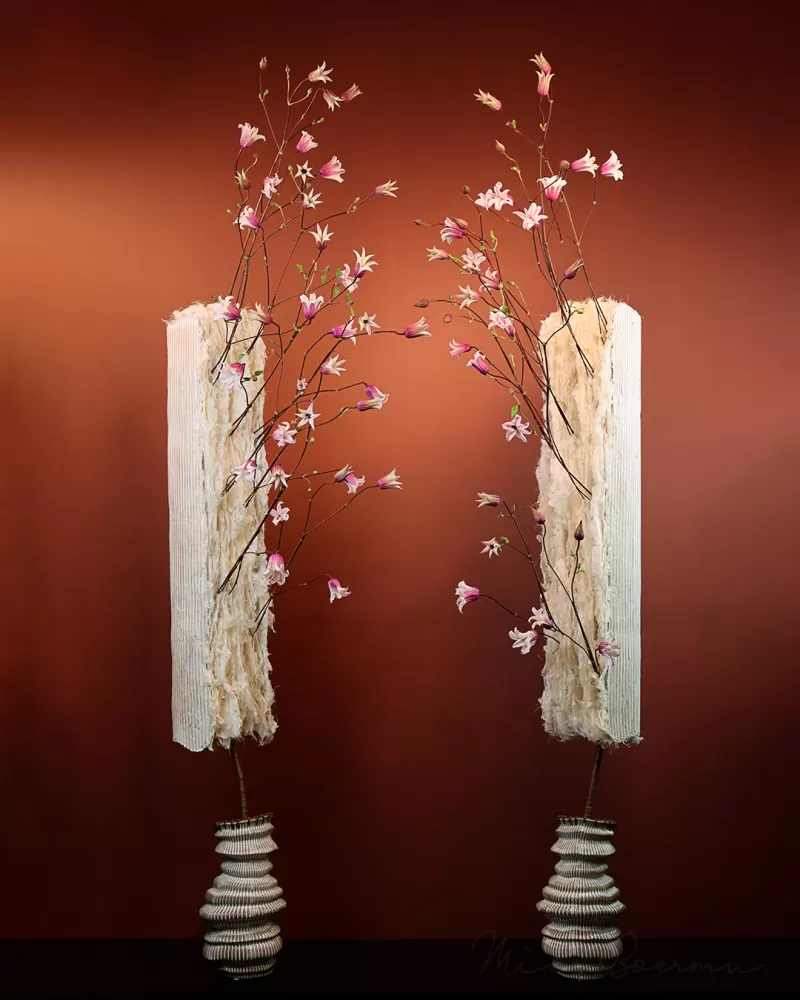
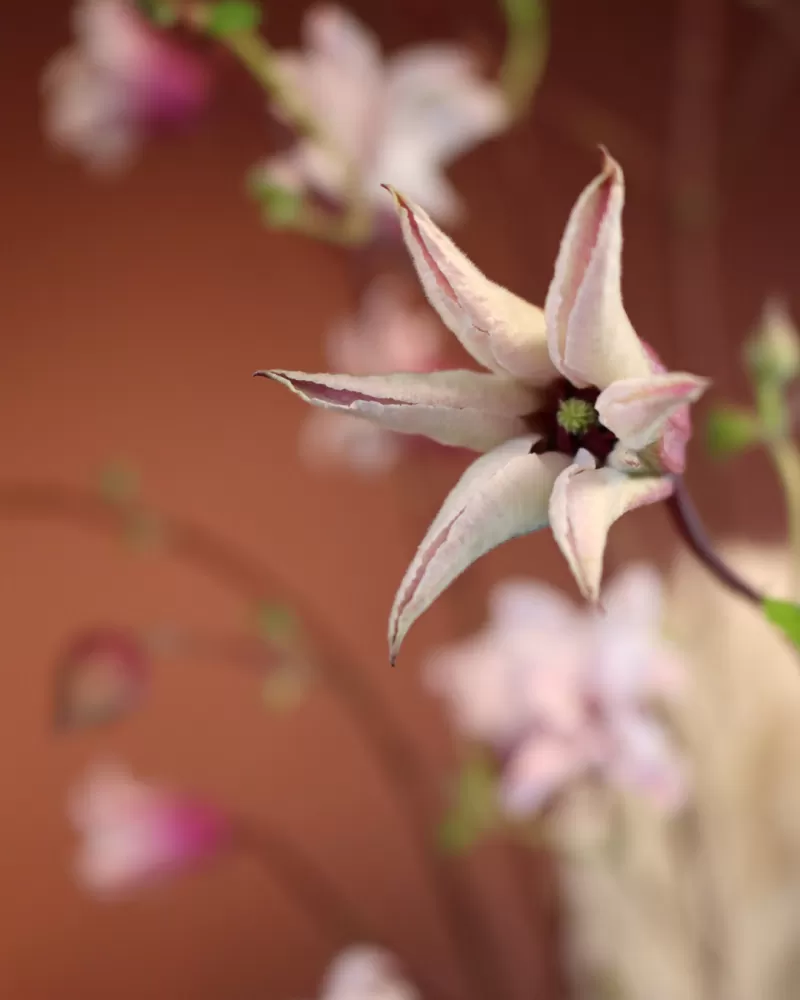
Flowers: Clematis Amazing® Sevilla
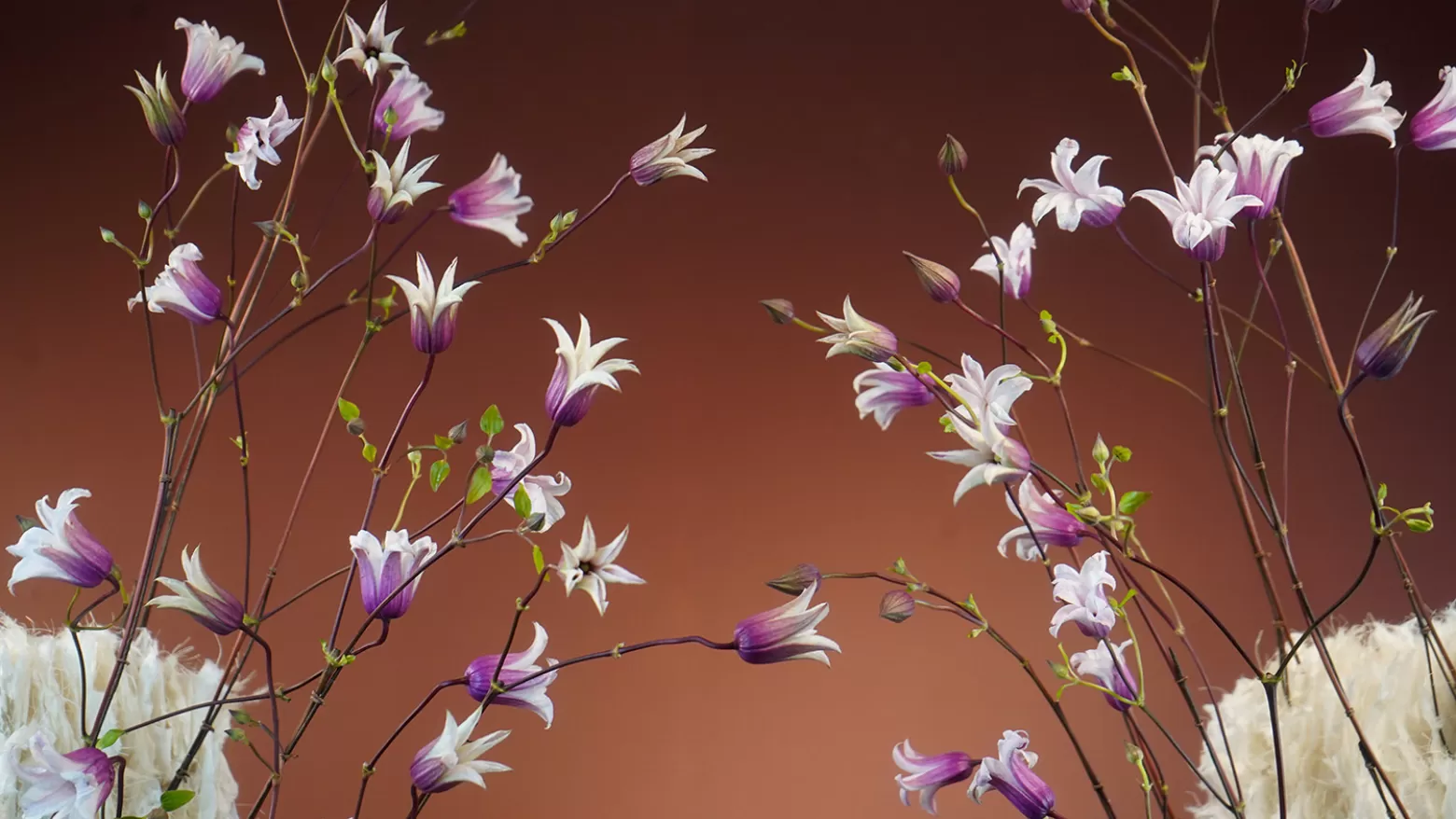
Washi paper is a material much loved by florists for its texture and flexibility. Like a dream, these beautiful Clematis seem to float out of the structure. The Clematis itself has a delicate, fragile texture. Almost paper-like, which pairs perfectly with the washi. I chose to work exclusively with the stunning Clematis Amazing® Sevilla, without a doubt my favourite from the Marginpar line. It has an adorably unique shape and a lovely vintage pink hue that I find utterly charming.
Trend 3: Haute Couture & Romance
Inspiration: France, Frédéric Dupré
If there’s anything the French are known for, it’s haute couture and romance. When I think of French floristry, and the florists who inspire me, my thoughts often turn to the intricately detailed work of Frédéric Dupré. The textures, the craftsmanship: that’s what draws me to his style. I’ve learned a great deal from Frédéric, particularly about texture. He regularly teaches a seminar on the subject at our school in Aalsmeer, and it’s always a highlight.
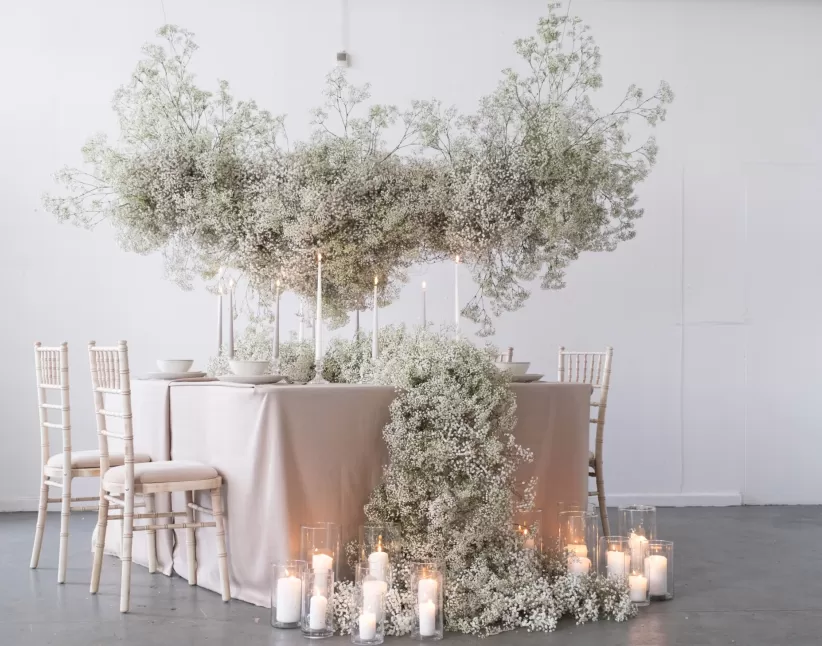
To give some context to this bouquet: history has shown that when the world takes a darker turn, we begin to seek out romance and nature. What better way to meet that need than through floristry? Sometimes, we simply need a bit of escapism; a comforting blanket of romantic imagery to help soothe the soul.
Occasionally, ideas seem to hang in the air, with multiple designers arriving at a similar concept around the same time. That was the case with the new standing bouquet techniques. This particular bouquet was created using a method I learned from Frédéric, but interestingly, I came across a similar approach not long before, through Gregor. Each of them tackles the concept differently, however. Frédéric’s technique stems from a variation of the ‘spider-web’ method: you begin by constructing a base or “foot”, then allow the supporting wires to open upward like the branches of a tree. The technique involves binding at a single point at the bottom, giving the effect of a hand-tied bouquet with the lower portion removed.
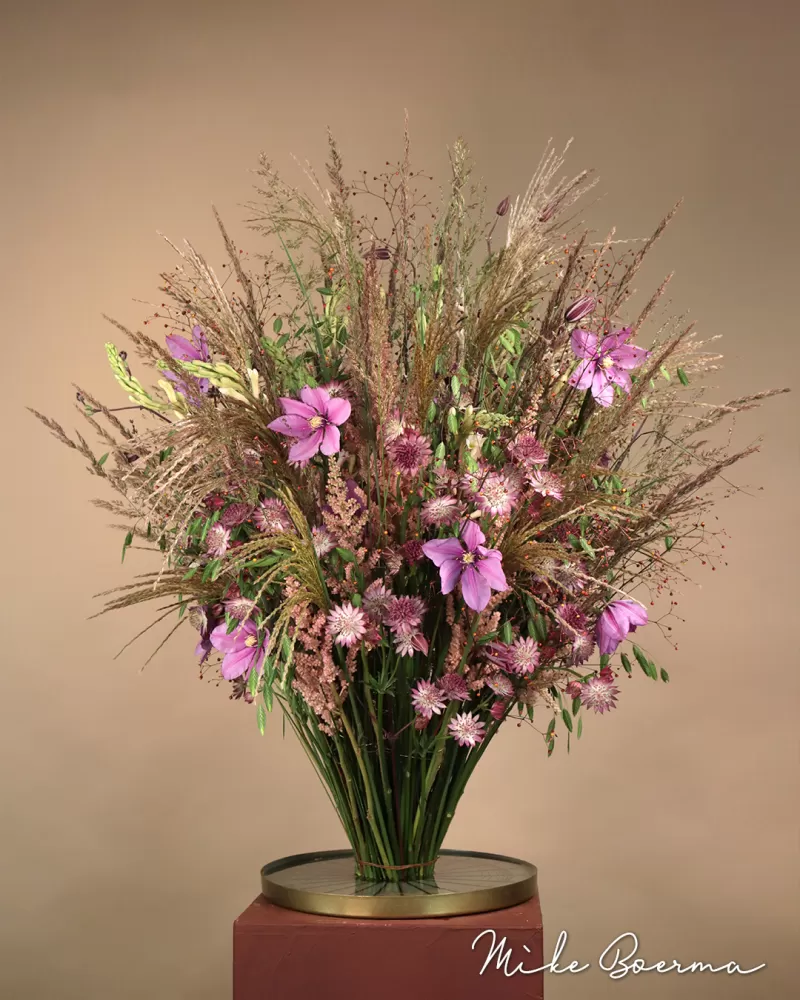
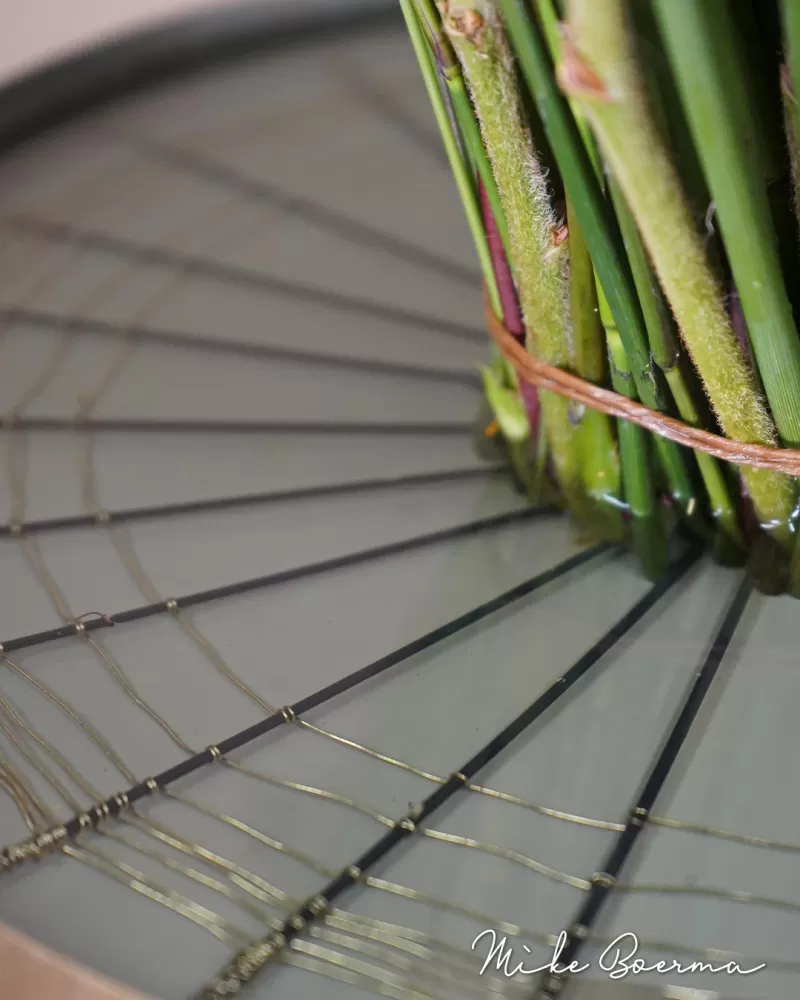
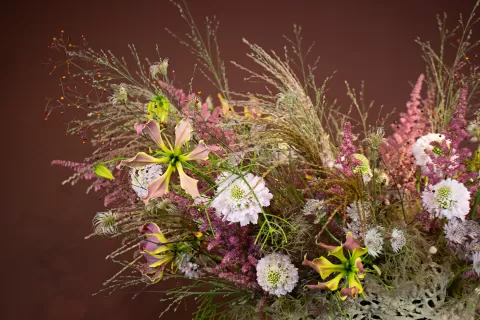
Flowers: Clematis Amazing® Tokyo, Miscanthus White Cloud, Talinum ‘Long John’, Polianthes Elsa Blush, Astrantia Roma®, Chasmanthium Latifolium 'Mantis', Astilbe Vision Inferno, Panicum Warrior
Gregor’s method, on the other hand, uses two dreamcatcher-like rings to support the stems, which then cross in a more woven, interlaced manner. Both approaches aim for a similar structural outcome, yet they yield visually distinct results. That’s why I believe it’s so important to keep studying and attending workshops: you never know what inspiring techniques you’ll discover. It broadens your creative range and allows you to adapt ideas to your own sensibilities, eventually incorporating them into your personal style.
The botanical selection in this bouquet reflects the romantic mood I was aiming for. Soft, fluffy grasses evoke the feeling of a natural meadow. The delicate petals of Clematis Amazing® Tokyo, with their fluffy centres, echo those grassy textures. Astrantia strengthens this connection with its intricate, tactile surface. Here and there, the heads of Polianthes emerge. Nestled within this soft blanket of textures, even their sleek appearance takes on a gentler quality. The colour palette is a dreamy blend of soft pinks and muted purples. The golden tone of the elegant container is echoed in the warm, golden hues of Miscanthus 'White Cloud', tying the entire piece together with subtle refinement.
Trend 4: Elevated Elegance
Inspiration: Australia, Mark Pampling & Bart Hassam
As a teacher, I’m always looking for better ways to support my students. One question that comes up time and time again is: Where should I place my flowers? It’s a perfectly logical question, after all, placing flowers in the right spot is, in essence, our entire job. But don’t be fooled. While it may sound like a simple question, the answer can be as complex as you want it to be.
Art and mathematics are more closely connected than many people realise, or would care to admit, to be honest. No one in the creative sector does maths for fun (I certainly spent more time drawing during maths class than solving equations). However, through my ongoing studies, I’ve come to understand just how valuable the golden ratio is in any design-related discipline. And few apply it as skilfully as designers like Mark Pampling. Here’s my thinking: when you limit yourself to just a few materials, it forces you to be intentional with every choice. Each flower in the design must have a purpose. The result is a composition that feels honest, focused, and clear.
Another florist who comes to mind when thinking about the golden rule is Bart Hassam. When I think of his work, I think of technical excellence: designs with clean execution, clearly the result of years of dedicated practice and refined craftsmanship. Both Mark and Bart are also exceptional teachers, and I’m always incredibly grateful to host them at our school.
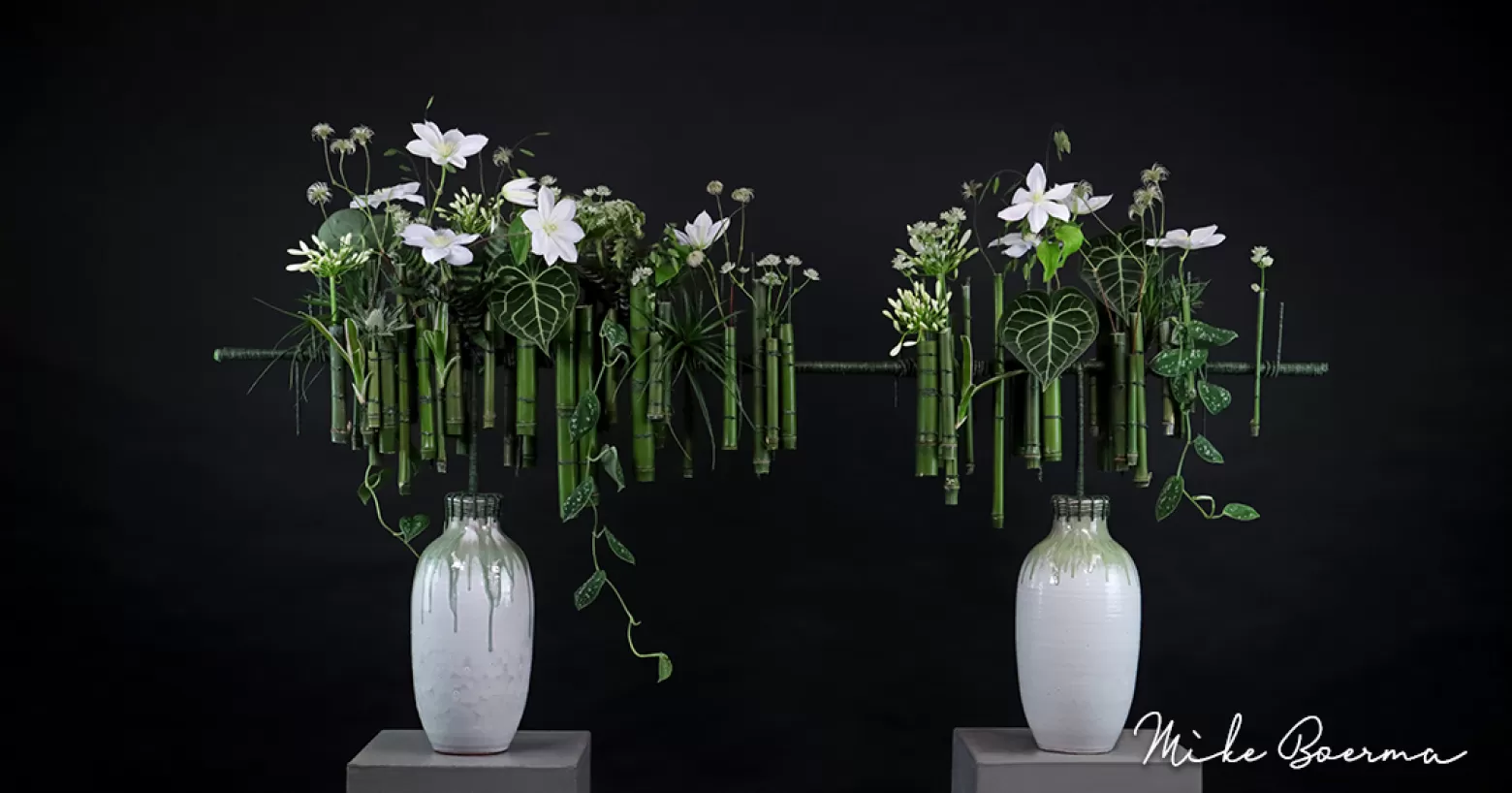
With that context, let’s look at the design itself. It incorporates a subtle Asian influence, reflected in the fresh green bamboo and a serene colour scheme, another source of inspiration I’ve absorbed from them. The palette is simple: green and white. With Marginpar’s remarkable range of white botanicals, this was an easy choice to bring to life.
The stunning Clematis Amazing® Vienna is a variety that seems to last for weeks. Its sheer size immediately commands attention, making it an excellent focal flower. Then there’s Clematis Amazing® Kibo, the one that resembles a soft little grey tuft of hair. It’s a brilliant botanical to have in your collection. It pairs beautifully with almost anything, adding a unique and intriguing texture.
Agapanthus Gletsjer echoes the waxy texture of the fresh green bamboo, creating harmony within the design. I’ve also used some Eryngium, with its rougher texture, which connects well with the playful, dancing movement of the Chasmanthium. This is another fantastic botanical that can bring a touch of whimsy and liveliness to any arrangement.
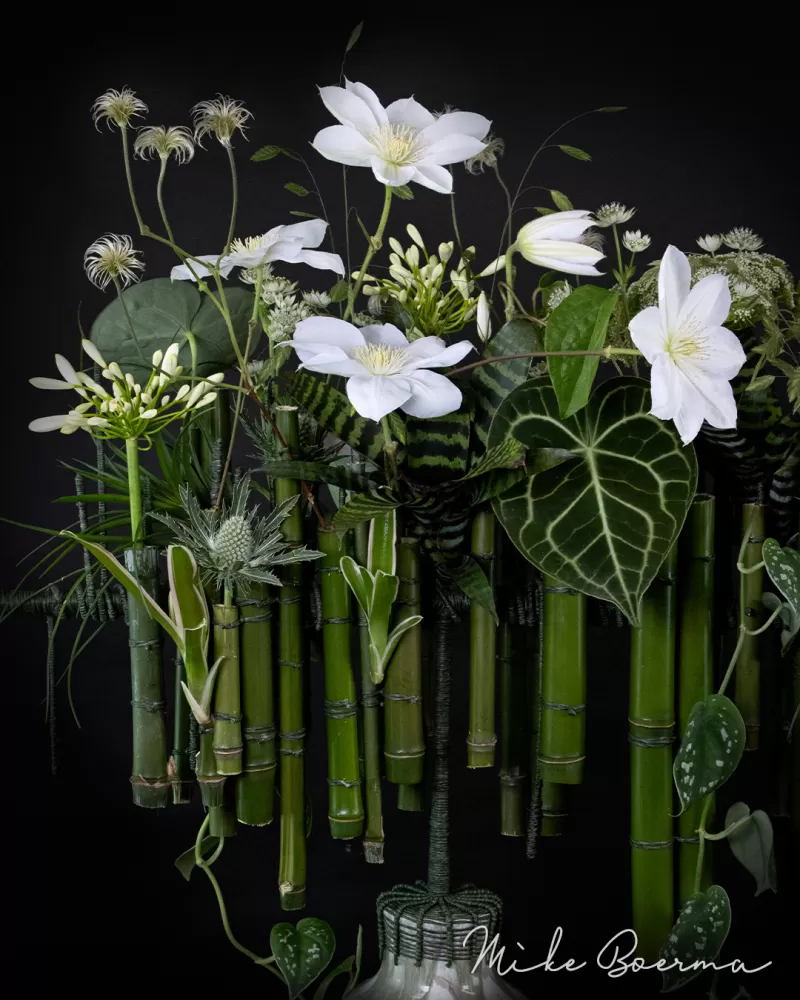
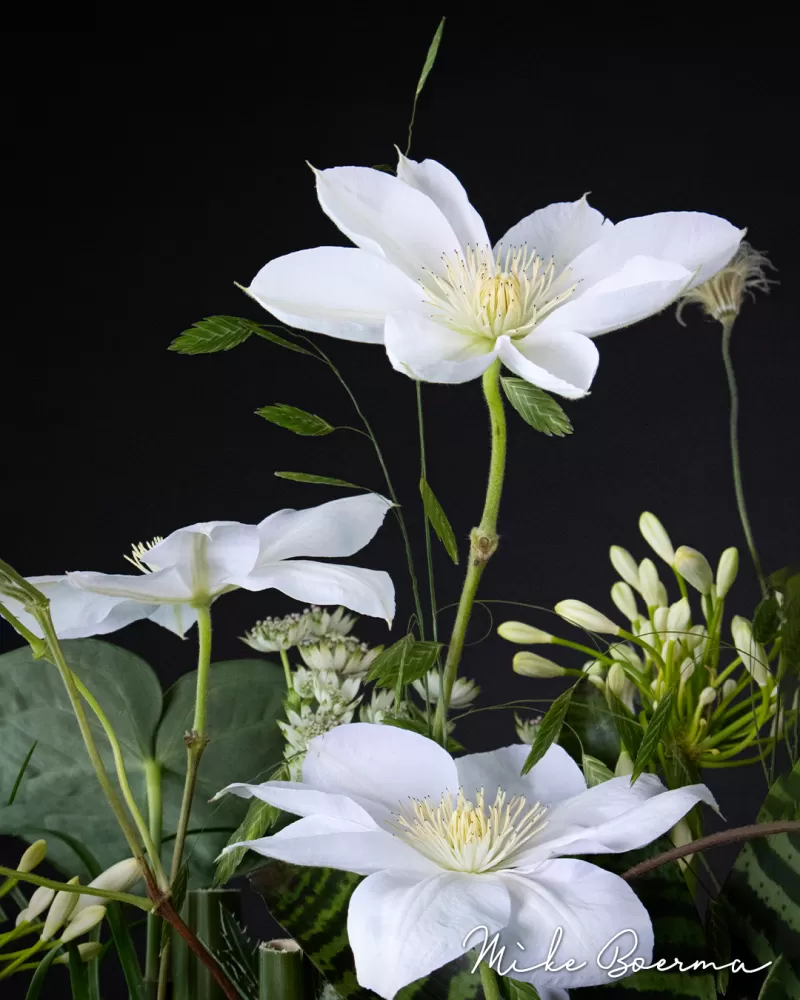
Flowers: Clematis Amazing® Vienna, Clematis Amazing® Kibo, Chasmanthium Mantis, Agapanthus Gletsjer, Astrantia Billion Star® XL, Eryngium Sirius Questar®
Trend 5: 'That New Insta Style'
Inspiration: The Internet
I don’t think this trend has an official name, yet. But I’ve heard people in Taiwan refer to it simply as "That Influencer Style". It doesn’t seem to have originated from one specific country either. I’ve seen it across social media accounts from Spain, Australia, Taiwan, the UK, and the USA. Designers like Susan McLeary, for example, have been at the forefront of this aesthetic. This is what happens when we’re all online together: influence flows in every direction.
What defines this style, in my opinion, is its use of a limited range of materials, but in abundant, sometimes overwhelming, quantities. It often features bold, funky, organic shapes created from just one type of botanical. At times, these pieces feel more like floral sculptures than traditional flower arrangements. Personally, I always find it exciting when designers push boundaries and explore non-traditional approaches to floristry. It opens up new ways of thinking and creating.
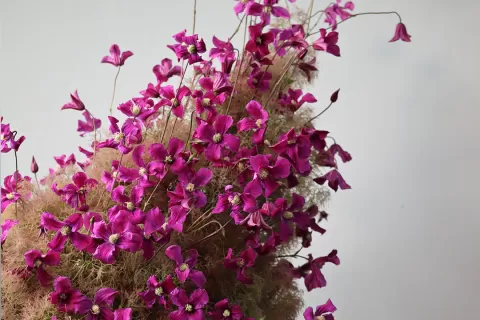
For this design, I thought it would be fun to build a striking shape using nothing but Cotinus. Once the base was formed, I gave the spotlight to another standout Clematis variety: Clematis Amazing® Kyiv. Kyiv has an incredibly vibrant colour that contrasts beautifully with the teal background. Paired with the smoky tones of the Smokebush, the result is an almost ethereal composition.
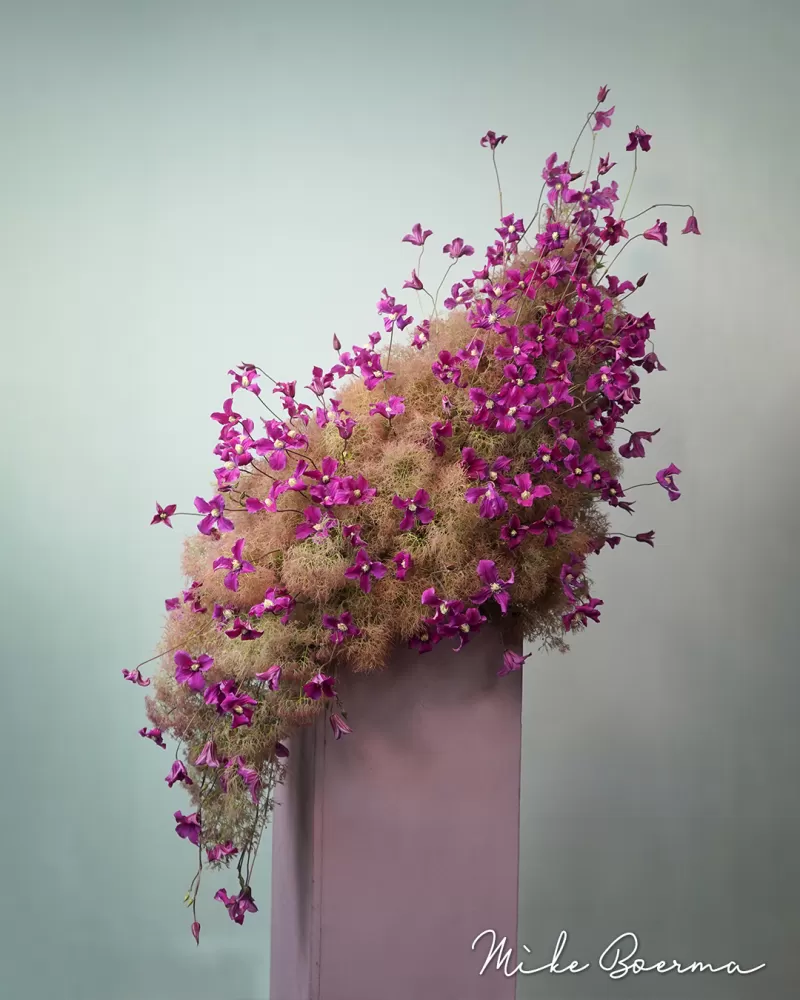
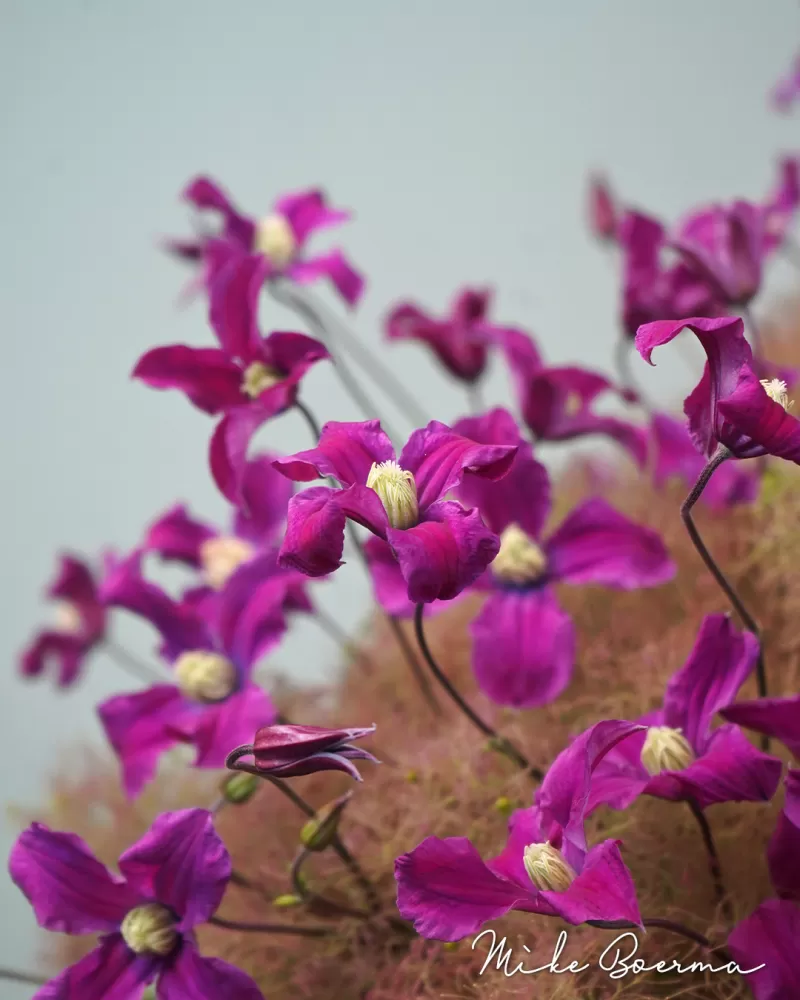
Flowers: Clematis Amazing® Kyiv
Trend 6: Open Silhouette
Inspiration: USA, Holly Chapple
Originating on Instagram and Pinterest pages in the USA, and brought to the forefront by designers such as Holly Chapple, this trend has been quietly evolving for years. It’s only recently begun to reach a broader audience.
Once known simply as Boho, the style has since emerged from its pampas grass cocoon, transforming into a more expressive and playful design approach, one that, in my opinion, has real staying power. At its inception, this style was largely championed by designers who lacked formal floristry training. This sparked a conversation among international floristry educators, who came together to identify the trend’s defining characteristics in order to make it more teachable and accessible.
Their conclusion?
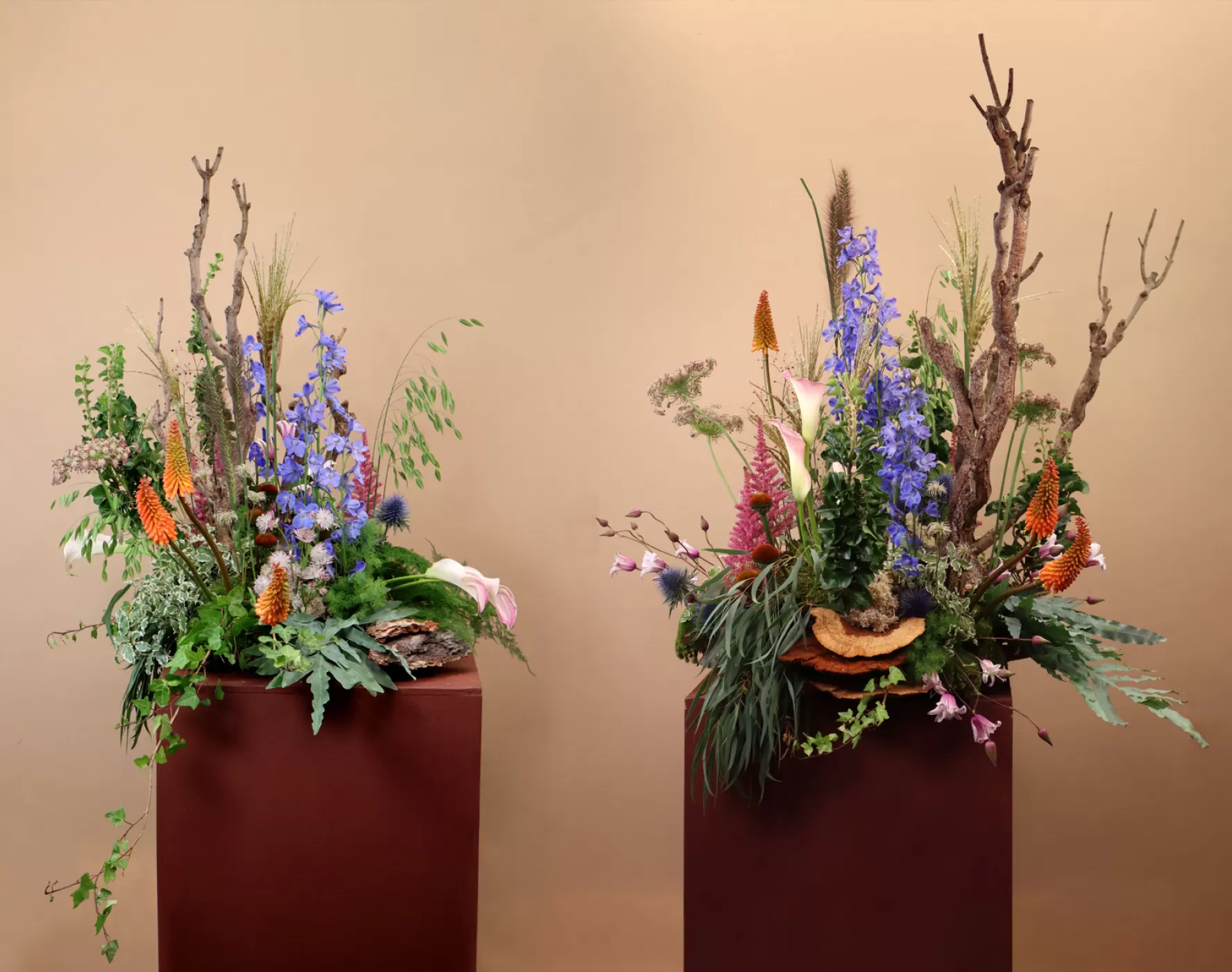
It’s asymmetrical. It lacks a defined silhouette or outline, often taking on an amorphous shape. It follows the golden rule in flower placement: flowers appear more densely grouped in some areas and more spaced out in others, creating a rhythmic visual flow. It’s a fun, relaxed style that I genuinely enjoy working in. It allows for a bit more expressiveness and nonchalance in the creative process.
When selecting flowers for a design in this style, I usually begin by choosing varieties with pointed forms, such as Delphinium, Astilbe, or Antirrhinum. These help me establish an open silhouette, which would be more difficult to achieve with round or flat-headed flowers. Those softer forms, like Helleborus, Echinacea, and Eryngium, are usually added later to fill in the structure and provide contrast in both form and texture.
The final result is a rather busy design, full of variation in colour and shape. However, because the palette here is composed mainly of pastel tones, the overall effect is balanced and calming.
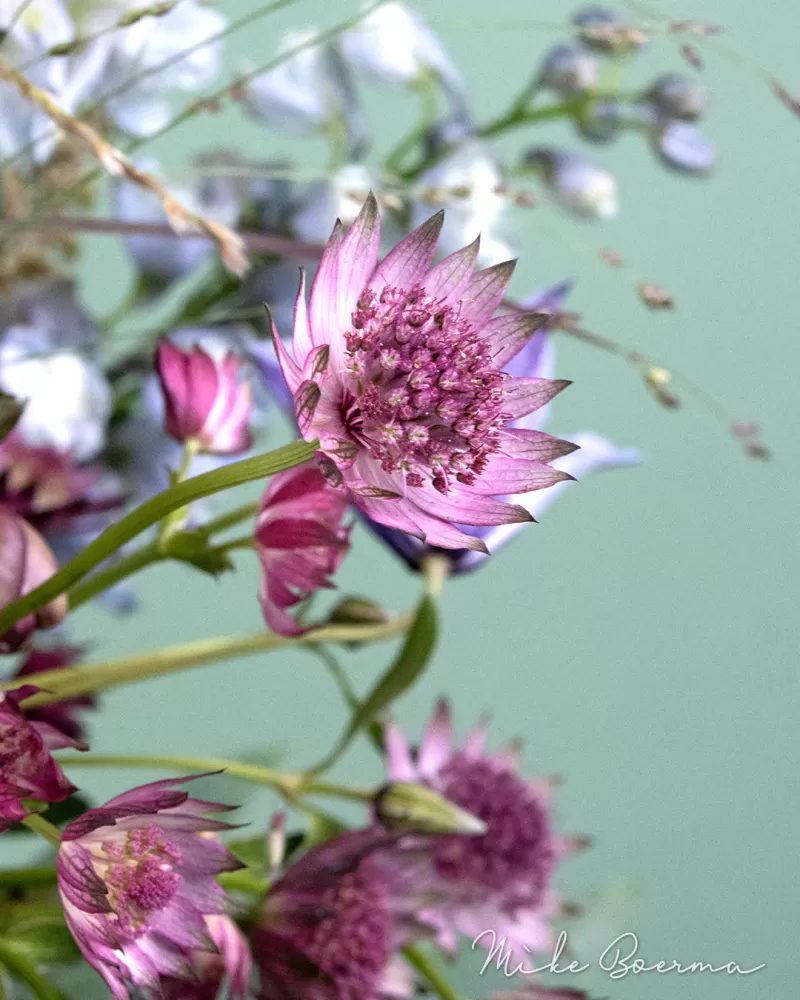
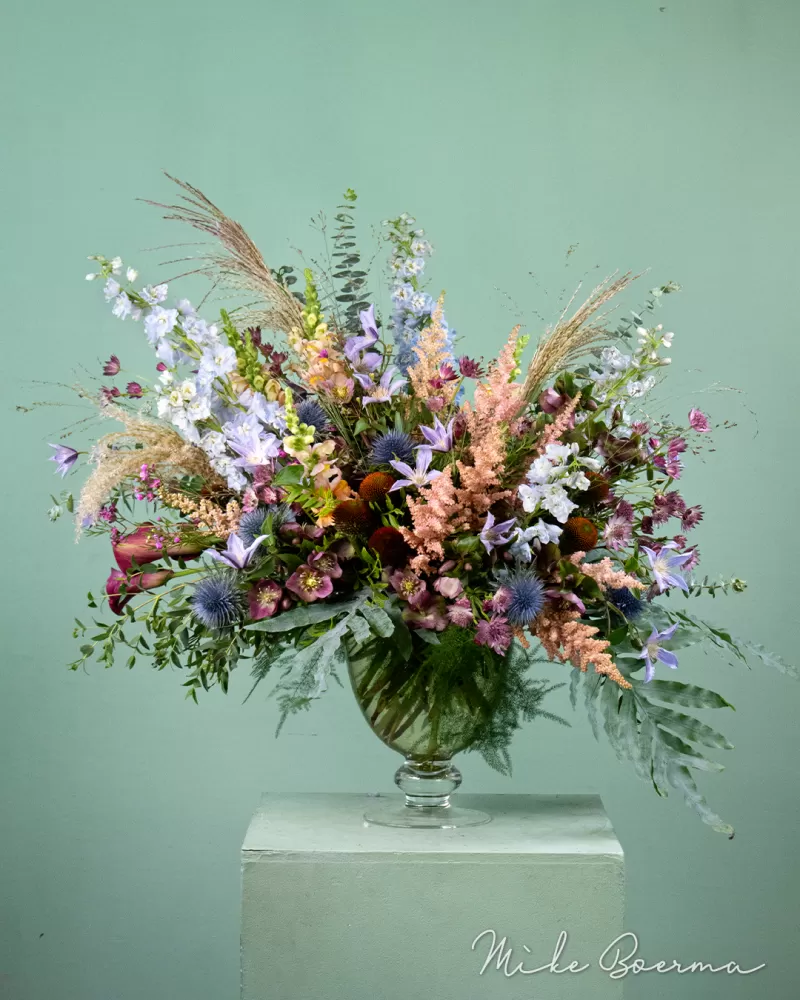
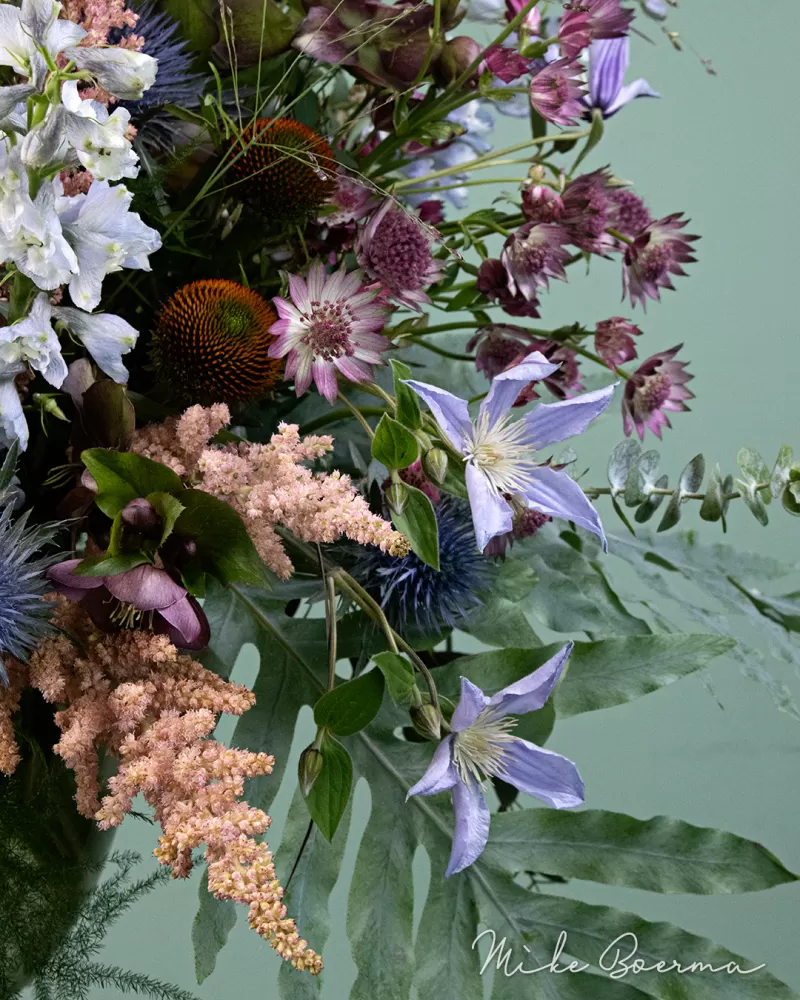
Flowers: Delphinium Guardian Lavender, Panicum Heavy Metal, Miscanthus White Cloud, Astilbe Vision Inferno, Clematis Amazing® Star River, Echinacea Purpurea, Eryngium Magnetar Questar®, Helleborus Mammoth Pink, Astrantia Star® of Love
Trend 7: Standing Bouquet in a different way
Inspiration: Taiwan and various friend
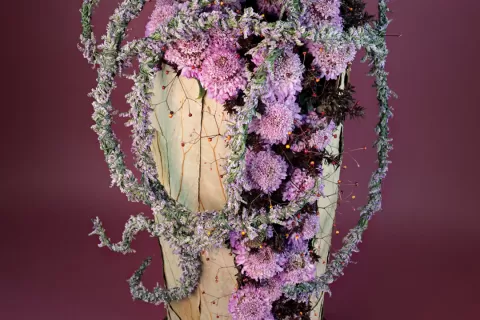
The dried lotus leaves used in this structure were a gift from Wenyu Chang, one of the co-directors of the Boerma Instituut in Taiwan. Commonly used in Southeast Asian medicine, these leaves also have a stunning texture and colour, making them perfect for a frame like this.
Earlier, I spoke about standing bouquets and how creative ideas often seem to float around, waiting to be picked up by different designers. This particular standing bouquet uses a technique I learned directly from Gregor Lersch. It involves two dreamcatcher-like rings, which act as technical support for the bouquet’s stems, and connects to a variation of the traditional spiderweb technique.
This method allows for shapes that would normally be quite challenging to construct. In this case, it enabled the creation of a large vertical bouquet. Personally, I feel that standing bouquets beautifully bridge the gap between artistic craftsmanship and commercial design; they offer great creative potential, yet can be made quite efficiently.
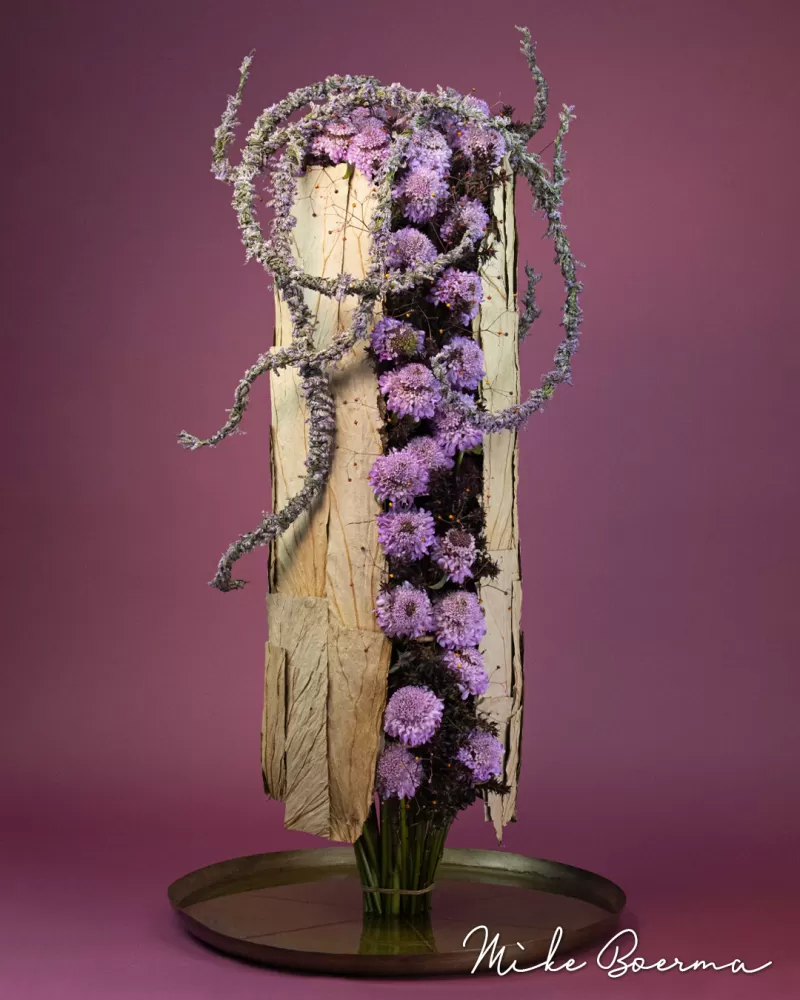
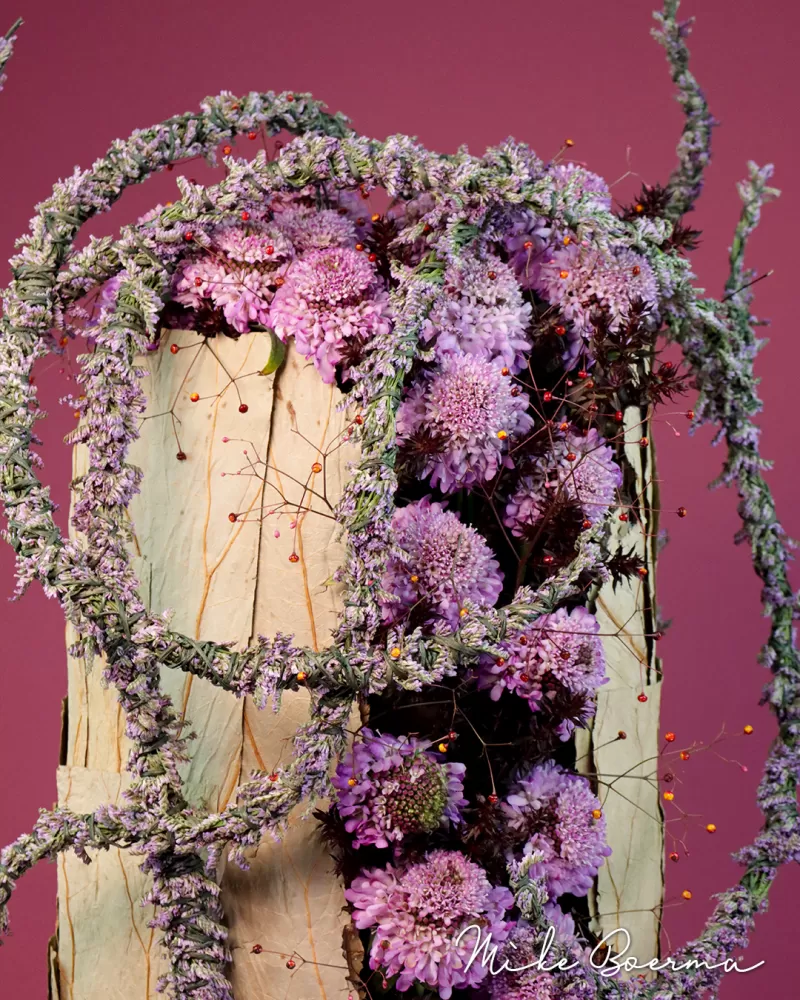
In contrast to the previous design, I wanted to limit the variety of flowers used. For this piece, I worked with just a few key ingredients: Limonium, Scabiosa, Talinum, and a particularly interesting variety of Phlox from Marginpar called Blind Loin, which I think has a really striking character.
The Talinum acts as a connector between the orange veins of the dried lotus leaves and the pinkish-purple hues of the Scabiosa, which in turn ties into the pastel lavender of the Limonium. The bouquet’s cylindrical structure introduces a sense of formality, which is beautifully contrasted by the wild, twisting lines of the Limonium guirlandes. These playful elements are affixed to the bouquet using fine wire, creating both movement and cohesion.
Trend 8: Clay Creation
Inspiration: Singapore & Frédéric Dupré
I originally created the sketch for this organic-looking shape for a demonstration in Singapore in 2024. At the time, the structure was built using nothing more than florist wire and green floral tape. I placed the flowers in a ring shape at the top, and the overall look and feel were completely different. The texture and colour palette gave it an entirely separate character.
But rather than discard a structure like this, I find it far more interesting to repurpose it, experimenting to discover what new possibilities it might offer. This time, I wanted to give it a completely different appearance. So, I covered the frame in a mix of wood glue, clay, and a bit of a secret sauce I picked up during my studies with Frédéric Dupré.
Flowers: Gloriosa Superba Simba Fifty Shades, Scabiosa Bon Bon Scoop™ French Vanilla, Clematis Amazing® Kibo, Miscanthus White Cloud, Astilbe Vision in Pink, Astrantia Star® of Africa, Astrantia Roma®, Talinum ‘Long John’, Panicum Heavy Metal

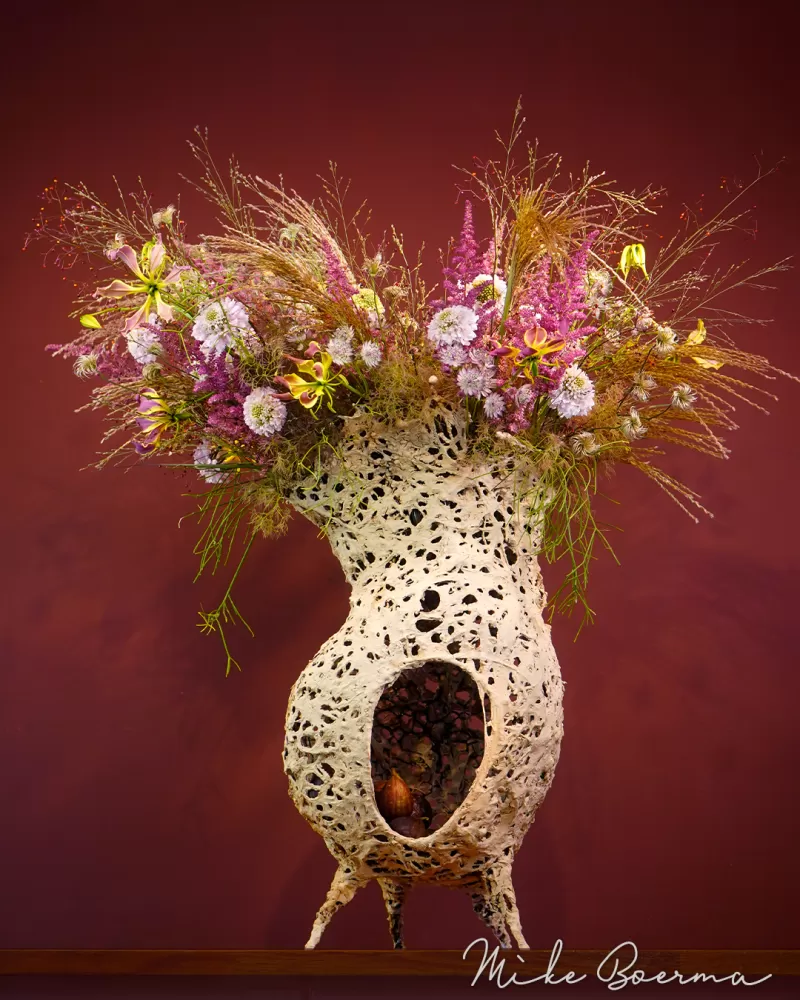
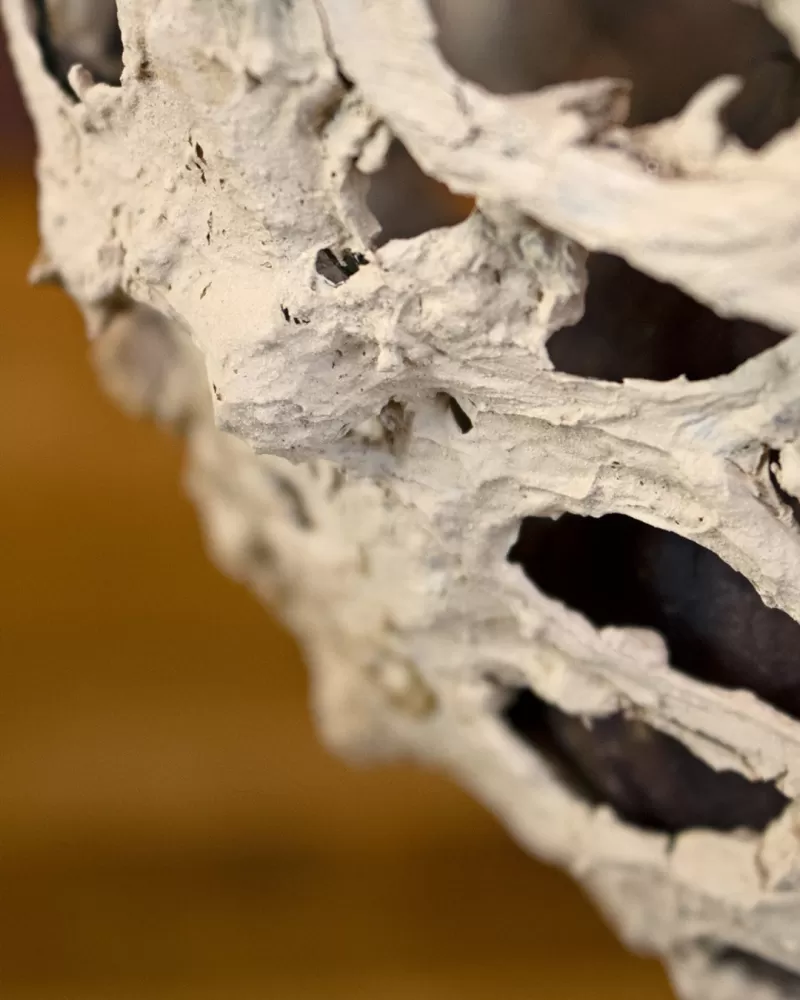
The result is a structure that looks as though it might have been built by a bird; organic, imperfect, and full of character. The botanicals I chose this time lean toward a muted colour palette, with just a hint of freshness here and there. The textures are a balanced blend of softness and earthiness.
For this design, I used Gloriosa, Scabiosa, Clematis, Miscanthus, Astilbe, Astrantia, and a few stems of Rhipsalis, freshly cut from one of our school’s plants. The final piece feels grounded yet whimsical, much like the journey this structure has taken from one continent and concept to another.
Trend 9: Floral Headdresses
Inspiration: USA, Francoise Weeks & Susan McLeary
The United States is a big place; far too many designers to name! So I think I can be forgiven for drawing a bit more inspiration from across the Atlantic ;) Also, Michigan and Portland are practically neighbours to Canada, right? And let’s not forget: Françoise Weeks is originally from Belgium… so I’d say that’s enough justification for featuring this beautiful trend!
Back on topic:
Floral headdresses are a captivating and expressive trend, blending tradition with contemporary creativity. They’re wearable floral art, commanding attention not just for their visual impact but for the story they tell. Historically, floral crowns have been symbols of celebration, fertility, and femininity across many cultures. Today, they’re being reimagined by designers worldwide to express personality, artistry, and innovation.
What makes this trend so exciting is its versatility. A floral headdress can be a lush, botanical ode to nature, like Françoise Weeks’ woodland masterpieces, or minimal and refined, as seen in Susan McLeary’s delicate modular designs (a headdress that transforms into a bridal bouquet? Sheer genius!). There are countless techniques to craft a beautiful floral crown. Françoise has her own signature approach, and Susan offers entirely different methods.
As for me? I’ve developed more of a MacGyver-style method (I’ve never seen the show, just the expression): a base of handmade chicken wire, reinforced with duct tape. Not glamorous, but quick, and surprisingly effective!
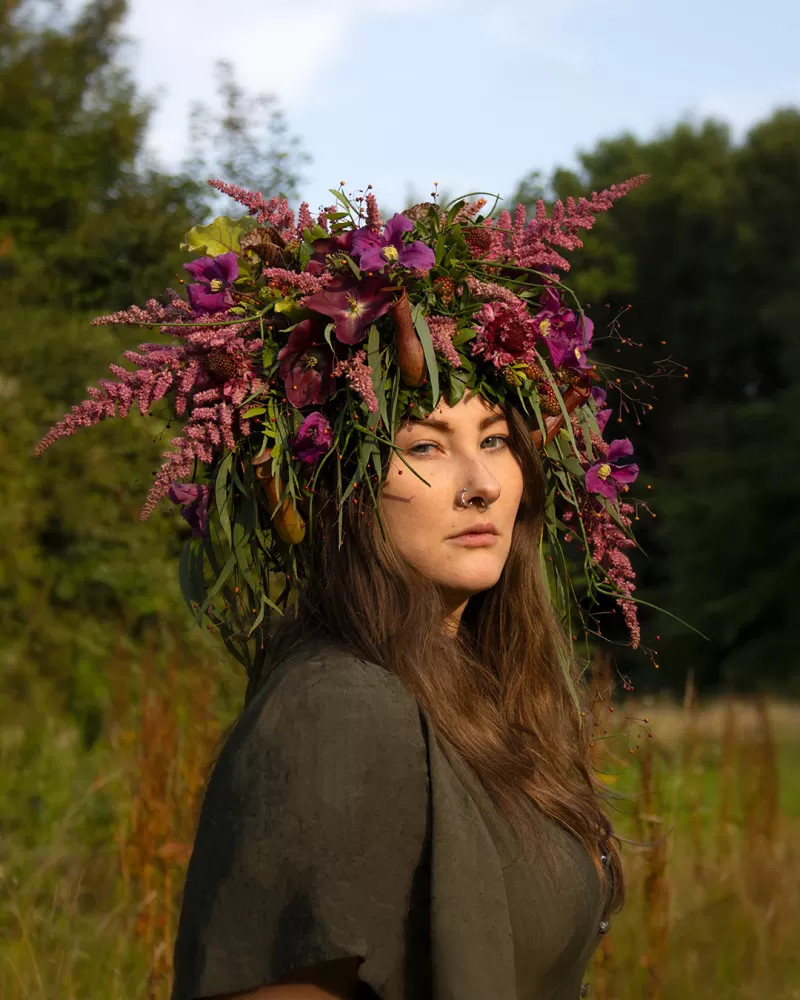
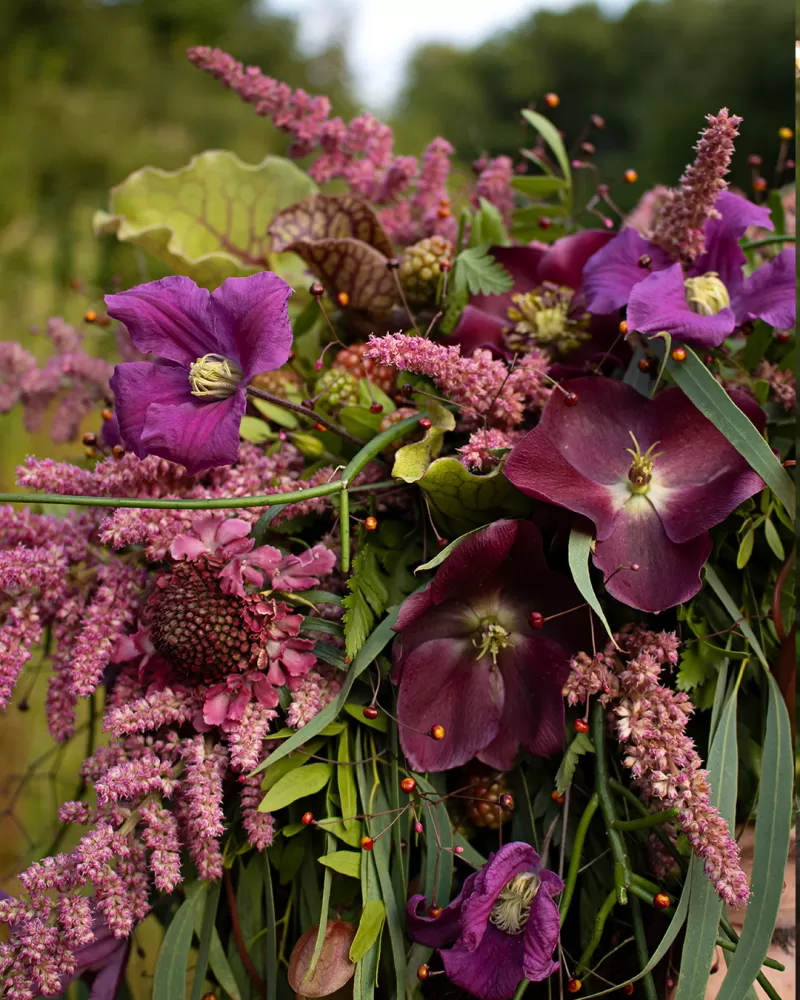
Flowers: Astilbe Vision Inferno, Helleborus Mammoth Red, Clematis Amazing® Kyiv, Talinum 'Long John', Scabiosa Dark Cherry Scoop®
Now, on to the botanicals:
Let me just start by saying, and no, I’m not being paid to say this, Marginpar’s Astilbe is some of the strongest I’ve ever used. By the time I was working on this headdress, the Astilbe was already over ten days old. I cut it in the morning, glued it to the structure, and then Anjelica and I headed off to the Amsterdam Forest to photograph it. The shoot took a few more hours in the heat and sun. And yet, by the time I sat down to write this article the next day, the Astilbe was still standing proud, its tips reaching up, beautifully dried.
I’ve had similar results with Astilbe ‘Vision Inferno’ from Marginpar. So, if you’re looking for a dependable Astilbe for an outdoor wedding, these are well worth seeking out. The Helleborus, another bloom that can be temperamental, also held up beautifully throughout the day. Other materials in the headdress included: Clematis Amazing® Kyiv, Talinum 'Long John', a variety of greens, and even some carnivorous plants (for that unexpected twist). Everything was glued directly onto the structure.
In essence, it’s a Boho-style arrangement in the form of a floral headdress. Of course, beautiful flowers are already half the work when creating something stunning. And a beautiful model is the other half. So really, all the work was done for me!
Trend 10: Dutch Garden Style
Inspiration: Holland and my grandfather, Theo Boerma
Although the name might suggest otherwise, Dutch Garden Style has nothing to do with the English Garden Style. It’s more of a fairytale-esque garden in which you should be able to imagine yourself walking through the paths.
From what I remember my grandfather once told me, it all started in the early 1960s, when a Dutch gentleman introduced the Parallel Style to florists at the Floriade. To be sure, I called Gregor to ask if he remembered the gentleman’s name, and he did. His name was Dre Hendersen. Apparently, Dre’s arrangement caused quite a stir at the time. “You call a few flowers, simply standing straight up, an arrangement?” was the general reaction.
I think that moment launched a new movement amongst those who did appreciate it and saw it as a revolution. To add fuel to the fire, the same Floriade also hosted Japanese Ikebana masters, whose demonstrations further challenged traditional Western floral aesthetics. These events undoubtedly contributed to the development of what we now recognise as linear floral styles. The Dutch Linear and the German Form Linear styles both found their origin there.
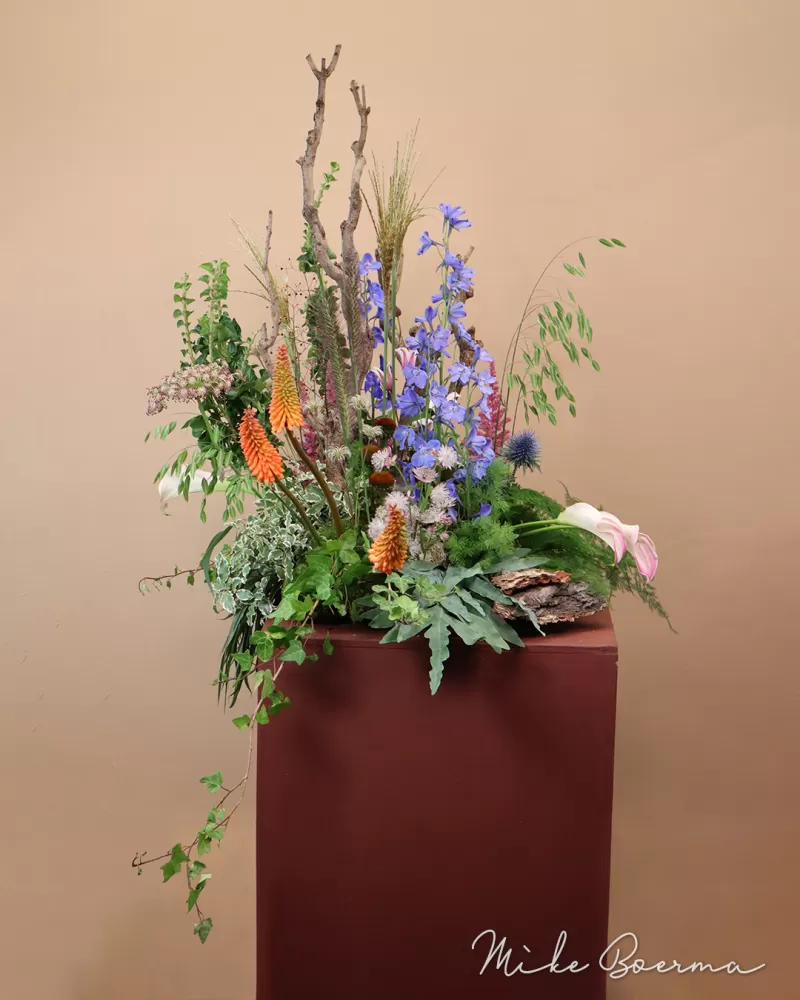
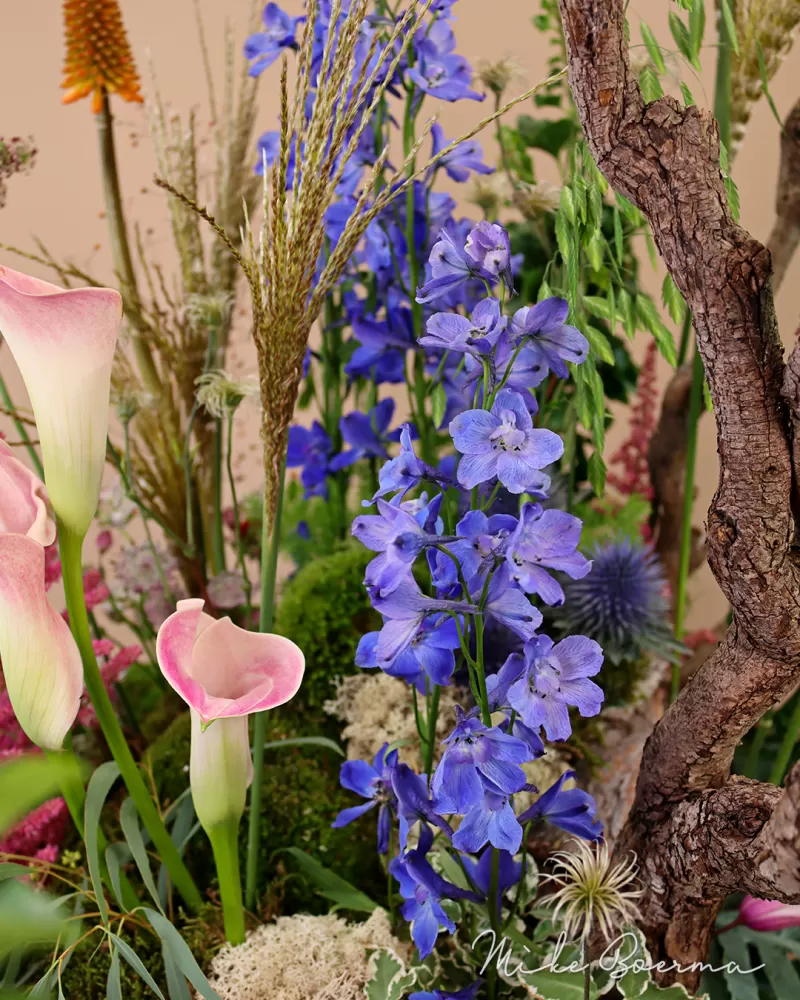
Later, this Dutch Linear style was “exported” by influential figures like Els Hazenberg and the team from the Flower Bureau of Holland, who travelled to the United States to promote Dutch flowers and floristry. A combination of these styles resulted in the Dutch Garden Style, a style that my grandfather was definitely one of the pioneers of. It is a style that we still teach during our Dutch Floral Design Programme today.
Why do I think it’s fitting as a trend for today’s time? It’s a way to explore natural themes in design, without going into vegetative style. It’s still a decorative style that can easily be commercialised.
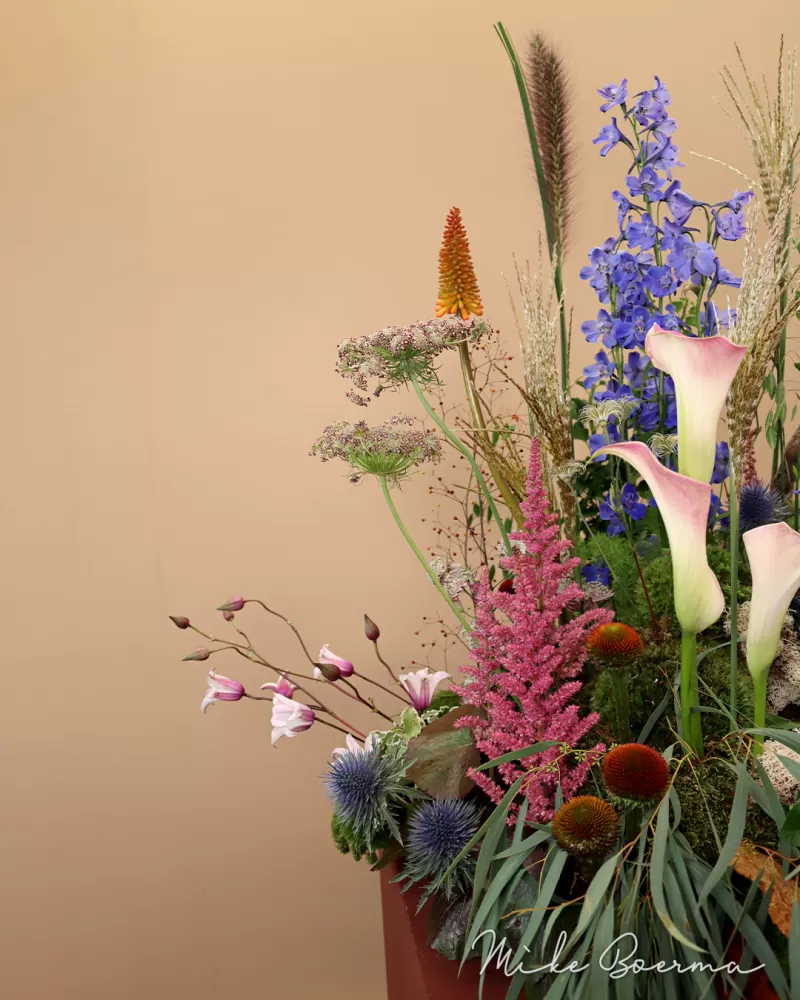
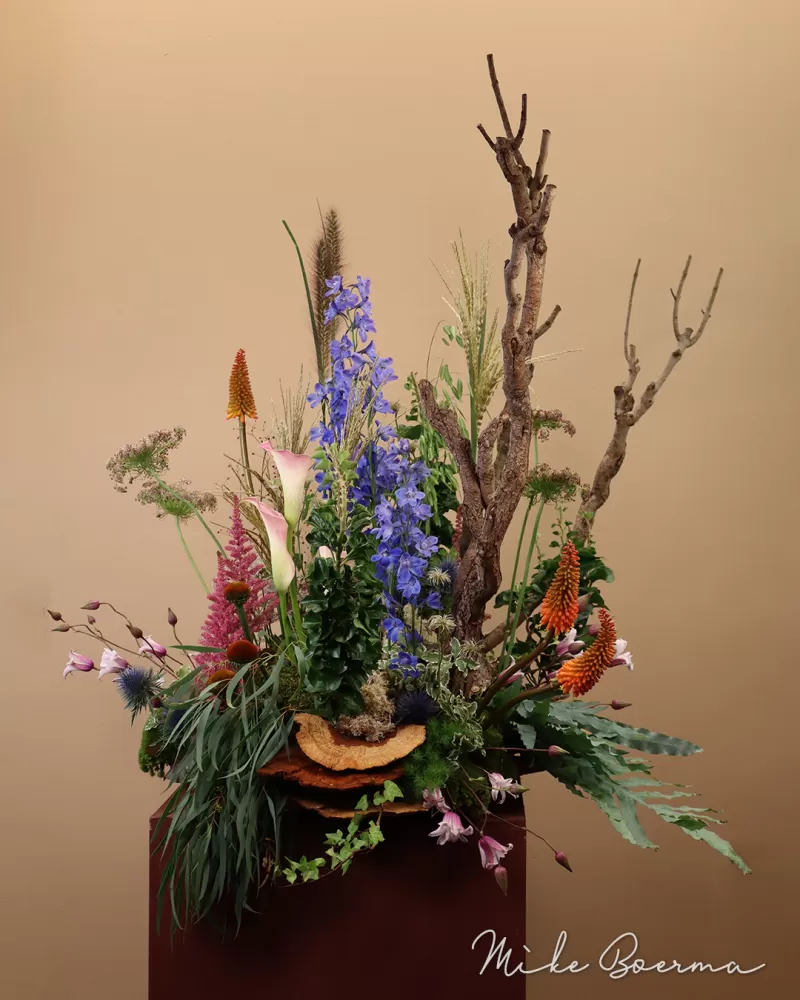
Flowers: Delphinium Bella Andes Azure, Chasmanthium Latifolium 'Mantis', Clematis Amazing® Sevilla, Eryngium Magnetar Questar®, Astilbe Vision in Pink, Daucus Carota 'Dara', Astrantia Star® of Africa, Talinum ‘Long John’, Miscanthus White Cloud, Echinacea Purpurea, Pennisetum Black Fox
About Mike Boerma
The Boerma name is well known in the world of floristry. Mike is the fifth generation of the Boerma family to work with flowers, and the third generation to be involved in the Boerma Instituut, an international floral design school based in the Netherlands.
Mike wears many hats: he teaches, works as a freelance florist for events, travels the world for floral demonstrations and to teach classes, and creates video content for floral enthusiasts on the Boerma YouTube channel. Since 2018, Mike has been an ambassador for Floral Fundamentals, a network of top designers and growers.
His goal as a teacher: “Helping students become the best florist they can be!”
Through his travels and the international reach of the Boerma Instituut, Mike has formed friendships with many masters of floristry around the world. He frequently assists designers such as Gregor Lersch and Frédéric Dupré during workshops and demonstrations in Europe, the United States, and Japan.
He also travels to floral events across the globe to help create spectacular large-scale installations alongside teams of fellow designers. The international nature of his work makes Mike the ideal choice for curating the floristry trends in this edition. He is constantly meeting designers, and discovering trends, from all over the world.
How special!
Want to stay updated on new developments, our sustainability efforts, and more designs like these? Be sure to follow us on social media: @marginpar and/or sign up for our monthly newsletter.